
Board views
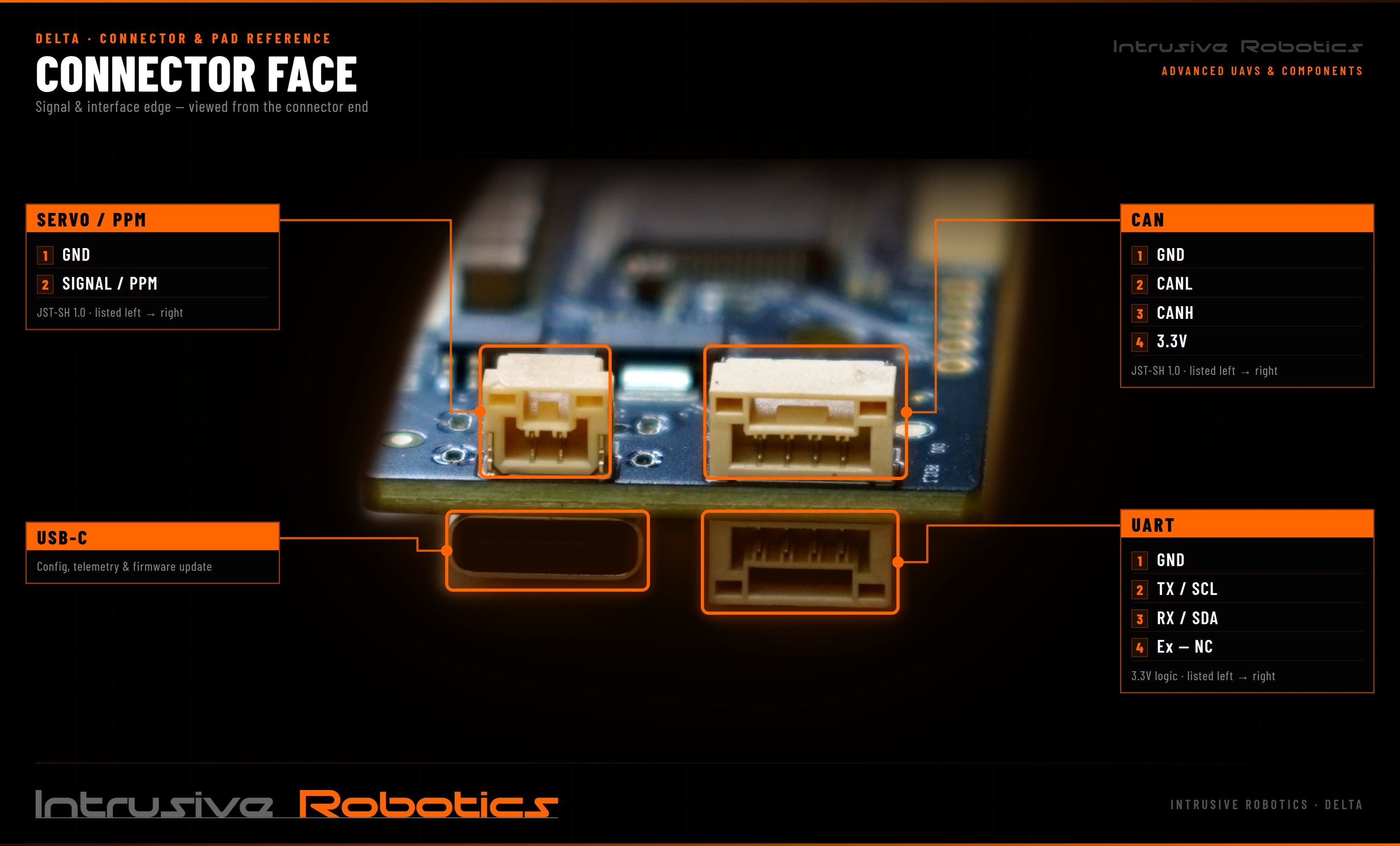
Connector face — signal and interface edge, viewed from the connector end
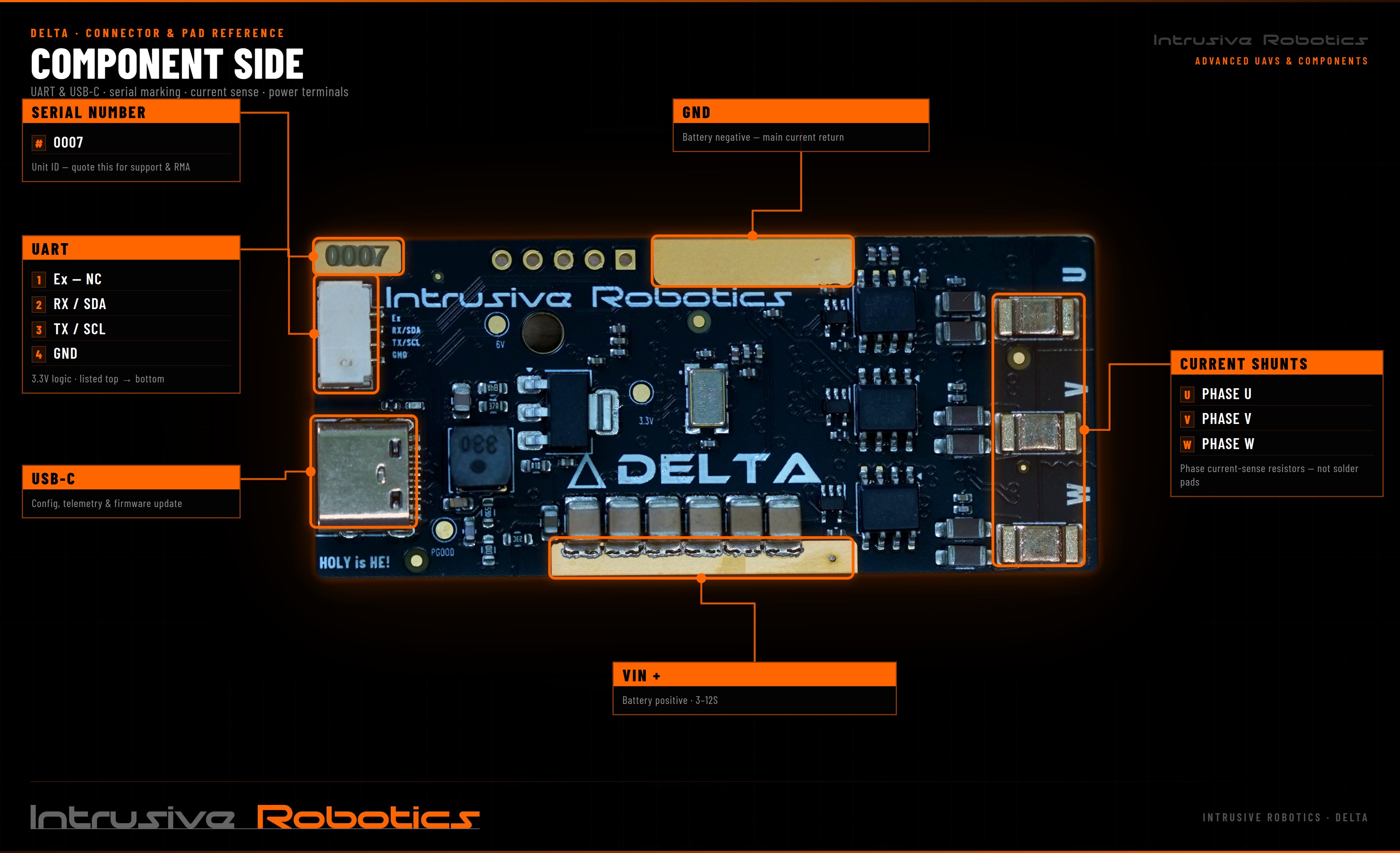
Component side — UART, USB-C, serial marking, current shunts and power terminals
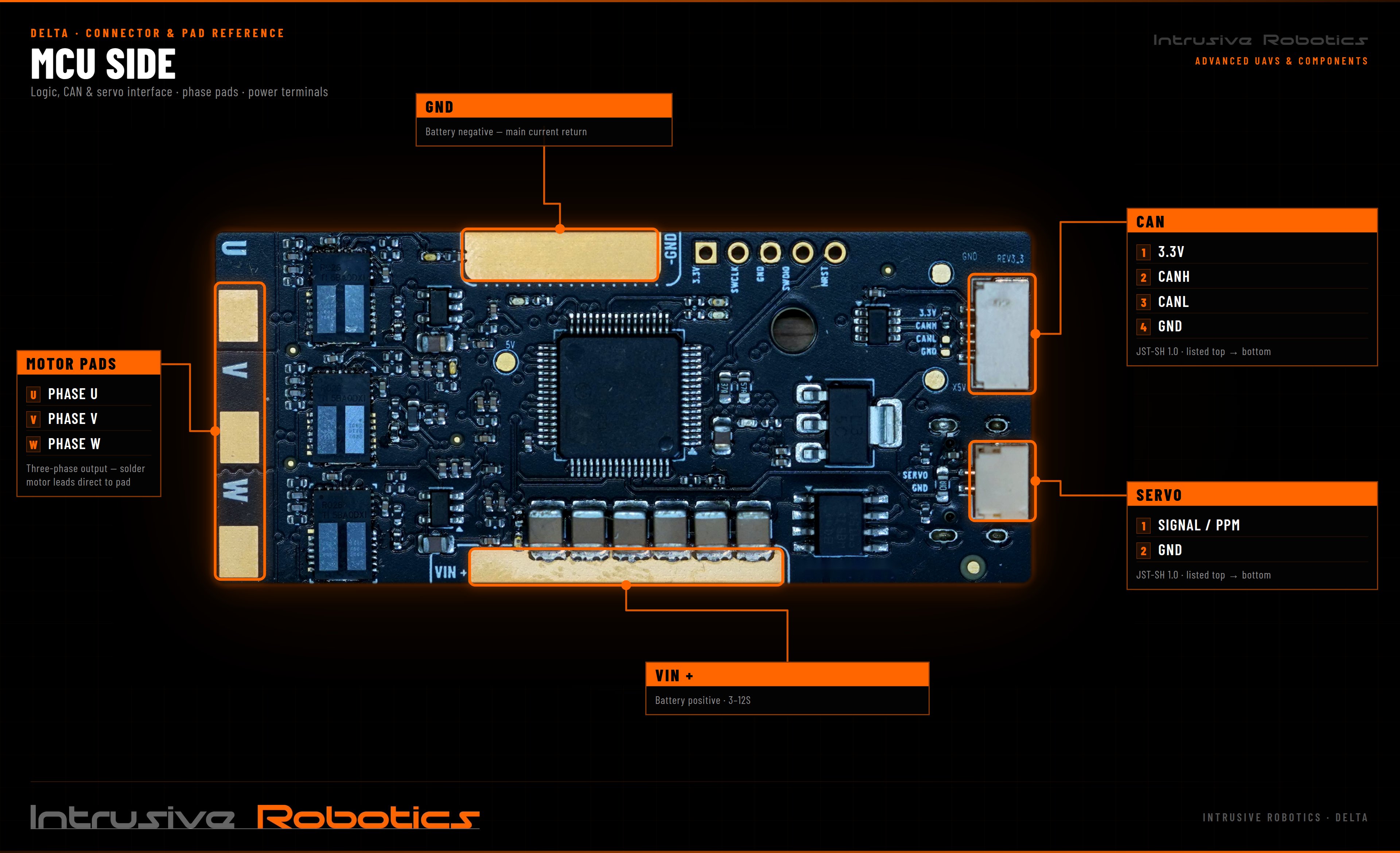
MCU side — logic, CAN and servo interface, phase pads and power terminals
Signal connectors
Servo / PPM
2-pin JST-SH 1.0. This is the PPM input configured in input configuration.CAN
4-pin JST-SH 1.0. Used for UAVCAN / DroneCAN and VESC-native CAN.UART
4-pin, 3.3 V logic.The data pins are shared between UART and I2C — TX doubles as SCL, RX as SDA. Which function is active depends on firmware configuration; the pins cannot serve both at once.
Ex is not connected.USB-C
Configuration, telemetry, and firmware update.Power and phase
Phase order determines direction of rotation. Prefer flipping the direction toggle in Motor Settings over swapping phase leads — see motor tuning.
Auxiliary power
The Delta’s low-voltage rails are sized for the controller’s own logic and gate drive. They are not a general-purpose supply, and auxiliary capacity is limited.Browning out the low-voltage rail takes the controller’s logic down with it. On a moving vehicle that means losing motor control.
Serial number
Each board carries a unit ID on the component side, next to the UART connector (for example0007). Quote this for support and RMA.
NDAA compliance
Serial numbers prefixed withN — for example N0007 — identify NDAA-compliant boards.
If NDAA compliance is a requirement for your programme, check the prefix on the physical board. The marking on the unit is the authoritative record.
3D model
STEP model of the Delta (Rev 3.3, no-header variant) for mechanical fit checks, enclosure design, and airflow planning.Download STEP model
delta-rev3_3-no-header.step — 9.8 MB, hosted on GitHubA STEP (ISO-10303-21) assembly exported from KiCad. The link opens the file on GitHub — use the Download button there, then open it in your CAD tool. It will not preview in the browser.
Not yet documented
Related
Input configuration
PPM, ADC, UART, and CAN control sources.
UAVCAN / DroneCAN
Running the Delta as a UAVCAN ESC node.